
CREA – Creative Europe – 2021-2027

Grants to support the audiovisual, cultural and creative sectors in Europe, awarded and managed in accordance with Title VIII of the Financial Regulation.

Budget

2.4 billion euros

Bénéficiaires

Association & NGO
EU & International Organisation
Large company (> 250 employees)
Local Authority & Affiliated Entity
Media & cultural organisation
Research centre & university
Smes & Start-Ups (< 249 Employees)

Type de financement

Grant – Co-financing

Budget
2.4 billion euros
Bénéficiaires
Association & NGO
EU & International Organisation
Large company (> 250 employees)
Local Authority & Affiliated Entity
Media & cultural organisation
Research centre & university
Smes & Start-Ups (< 249 Employees)
Type de financement​
Grant – Co-financing

The general objectives of Creative Europe are to safeguard, develop and promote European cultural and linguistic diversity and heritage; and to increase the competitiveness and the economic potential of the cultural and creative sectors, in particular the audiovisual sector.

Objectives

  • To enhance artistic and cultural cooperation at the European level in order to support the creation of European works and strengthen the economic, social and external dimension of and innovation and mobility in Europe’s cultural and creative sectors
  • To promote competitiveness, scalability, cooperation, innovation and sustainability, including through mobility, in the European audiovisual sector
  • To promote policy cooperation and innovative actions supporting all strands of the Programme and to promote a diverse, independent and pluralistic media environment, and media literacy, thereby fostering freedom of artistic expression, intercultural dialogue and social inclusion

Structure

  1. The Culture strand, which covers cultural and creative sectors with the exception of the audiovisual sector
  2. The Media strand, which covers the audiovisual sector
  3. The Cross-sectoral strand, which covers actions across all cultural and creative sectors

Priorities

Culture strand

  • To strengthen transnational cooperation and the cross-border dimension of the creation, circulation and visibility of European works and the mobility of operators in the cultural and creative sectors
  • To increase access to and participation in culture and to increase audience engagement and improve audience development across Europe
  • To promote societal resilience and to enhance social inclusion and intercultural dialogue through culture and cultural heritage
  • To enhance the capacity of the European cultural and creative sectors, including the capacity of individuals working in those sectors, to nurture talent, to innovate, to prosper and to generate jobs and growth
  • To strengthen European identity and values through cultural awareness, arts education and culture-based creativity in education
  • To promote capacity-building within the European cultural and creative sectors, including grassroots organisations and micro-organisations, so that they are able to be active at the international level
  • To contribute to the Union’s global strategy for international relations through culture

Media strand

  • To nurture talent, competence and skills and to stimulate cross-border cooperation, mobility, and innovation in the creation and production of European audiovisual works, thereby encouraging collaboration across Member States with different audiovisual capacities
  • To enhance the circulation, promotion, online distribution and theatrical distribution of European audiovisual works within the Union and internationally in the new digital environment, including through innovative business models
  • To promote European audiovisual works, including heritage works, and to support the engagement and development of audiences of all ages, in particular young audiences, across Europe and beyond

Cross-sectoral strand

  • To support cross-sectoral transnational policy cooperation, including cooperation on the promotion of the role of culture in social inclusion and cooperation on artistic freedom, to promote the visibility of the Programme and to support the transferability of the results of the Programme
  • To encourage innovative approaches to the creation, distribution and promotion of, and access to, content across cultural and creative sectors and other sectors, including by taking into account the digital shift, covering both market and non-market dimensions
  • To promote cross-sectoral activities that aim at adjusting to the structural and technological changes faced by the media, including enhancing a free, diverse, and pluralistic media environment, quality journalism and media literacy, including in the digital environment
  • To support the establishment of Programme desks in participating countries and the activities of Programme desks and to stimulate cross-border cooperation and the exchange of best practices within the cultural and creative sectors

Among financed actions

Culture strand

  • Horizontal actions
    • Transnational cooperation projects that bring together organisations in the cultural and creative sectors of all sizes, including micro-organisations and small-sized organisations, and from different countries to undertake sectoral or cross-sectoral activities
    • European networks of organisations in the cultural and creative sectors from different countries
    • Cultural and creative pan-European platforms
    • Transnational mobility of artists and operators in the cultural and creative sectors and the transnational circulation of artistic and cultural works
  • Sectoral actions
    • Support to the music sector: actions that promote diversity, creativity and innovation in the field of music, including live performance, in particular, the distribution and promotion of all musical repertoires in Europe and beyond, training actions, participation in and access to music, …
    • Support to the book and publishing sector: targeted actions that promote diversity, creativity and innovation, the promotion of European literature across borders in Europe and beyond, including in libraries, training and exchanges for sector professionals, authors and translators and transnational projects for collaboration
    • Support to architecture and cultural heritage for a quality built environment: targeted actions for the mobility, capacity-building and internationalisation of architecture and cultural heritage operators; the promotion of Baukultur, peer learning and audience engagement in order to disseminate high-quality principles in contemporary architecture and cultural heritage interventions; support to the sustainable safeguarding, the regeneration and the adaptive reuse of cultural heritage and the promotion of its values through awareness-raising and networking activities
  • Special actions
    • Financial support to the European Capitals of Culture
    • Financial support to the European Heritage Label and networking activities between the sites awarded the European Heritage Label
    • Union cultural prizes
    • European Heritage Days

Media strand

  • The development of audiovisual works by European independent production companies, covering a variety of formats (such as feature films, short films, series, documentaries and narrative video games) and genres, and targeting diverse audiences, including children and young people
  • The production of innovative and quality TV content and serial storytelling, addressing diverse audiences, by European independent production companies
  • Promotion and marketing tools, including online and through the use of data analytics, to increase the prominence, visibility, cross-border access, and audience reach of European works
  • Support to the multilingual access to cultural TV programmes online through subtitling
  • Initiatives promoting audience development and engagement, including film education activities, addressing in particular young audiences
  • European festivals and a European festivals’ network or European festivals’ networks screening a significant proportion of non-national European works, while preserving their identity and unique profile
  • A European cinema operators’ network, with a broad geographic coverage, screening a significant proportion of non-national European films, fostering the role of European cinemas in the circulation of European works

Cross-sectoral strand

  • Policy cooperation and outreach actions
    • Support policy development, the transnational exchange of experiences and know-how, peer learning and awareness raising activities, networking, and regular cross-sectoral dialogue among organisations in the cultural and creative sectors and policy makers
    • Fostering cross-border policy cooperation and policy development with regard to the role of social inclusion through culture
  • ‘Creative innovation lab’ actions
    • Foster innovative cross-sectoral approaches and tools which shall, where possible, encompass multilingual and social dimensions to facilitate the distribution, promotion and monetisation of, and access to, culture and creativity, including cultural heritage

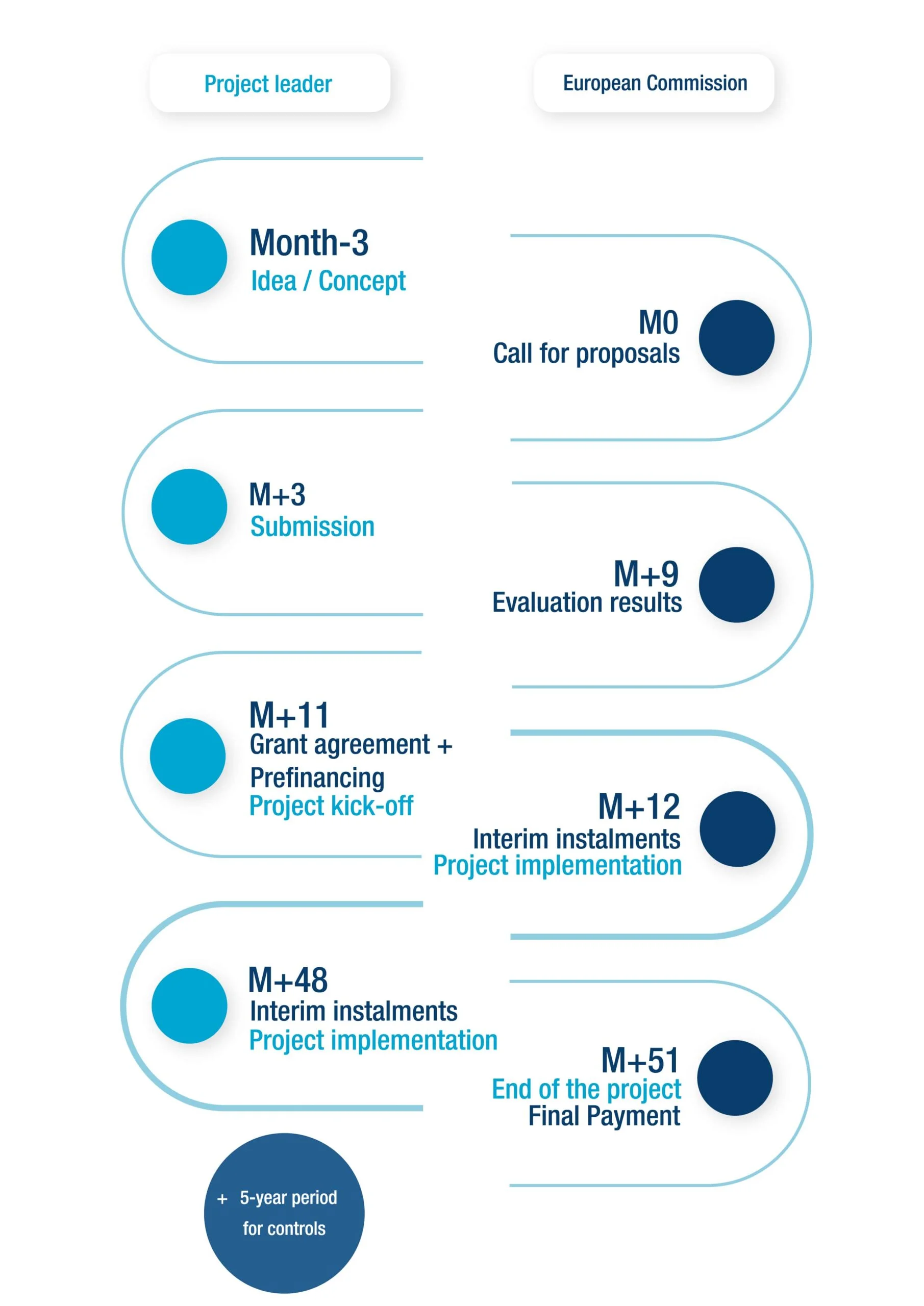
Comment ça marche ?

Need help with your public financing ?

Les autres fonds européens

LIFE

Transition vers une économie durable grâce aux énergies renouvelables

FSE+

Investir dans les citoyens pour une Europe sociale forte

ERASMUS+

Permet le développement des étudiants et de connecter l’Europe

CERV

Promotion de la diversité, l’égalité et les droits dans l’Union Européenne

Horizon Europe

Axée sur l’innovation et la recherche

Digital Europe

Accélérer la transformation numérique

Questions fréquentes

Vous ne trouvez pas la réponse que vous cherchez ?

Le Fonds européen de développement régional (FEDER) est un des principaux instruments financiers de la politique de cohésion de l’Union européenne. Pour la programmation 2021-2027, le FEDER a deux objectifs majeurs : le développement solidaire et durable des territoires et la compétitivité de l’économie. Il vise à réduire les écarts entre les régions et à favoriser le développement dans divers domaines d’intervention comme l’environnement, les énergies renouvelables et le développement urbain.

Pour la période 2021-2027, des milliards d’euros ont été alloués pour soutenir les projets dans les États membres et les régions ultrapériphériques. Les fonds sont répartis en fonction des besoins spécifiques de chaque région, et un taux de cofinancement est généralement appliqué.

Si vous avez un projet qui correspond aux objectifs et aux domaines d’intervention du FEDER, vous pouvez déposer un dossier de demande via le portail des aides. Il est essentiel de suivre la méthodologie du FEDER pour maximiser vos chances d’obtenir une subvention.

Des exemples de projets cofinancés par le FEDER sont souvent publiés sur le portail des aides et sur d’autres plateformes de la Commission européenne. Ces exemples peuvent donner une bonne idée des types de projets qui reçoivent un financement.

La programmation 2021-2027 met un accent particulier sur les transitions écologique et numérique. Elle vise également à renforcer la résilience des régions européennes face aux défis actuels et futurs.

Pour découvrir davantage sur le FEDER, vous pouvez écouter des podcasts, lire des articles, ou même participer à des webinaires et des sessions de formation. Le but est de vous fournir toutes les informations nécessaires pour naviguer efficacement dans le monde des fonds européens.

Ces questions et réponses ne sont qu’un aperçu des nombreux aspects du FEDER. Pour plus d’informations, n’hésitez pas à consulter le portail officiel et les ressources associées.

Need help with your public financing ?

Similar news

24 November 2022

Culture seen as a driver of health and well-being by the Commission and the Parliament

Lire l'aticle

23 September 2022

European Capital of Culture applications close in December

Lire l'aticle