UCPM – EU CIVIL PROTECTION MECHANISM – 2021-2027

Fund for: Strenghtening the cooperation between the Union and the Member States and to facilitate coordination in the field of civil protection in order to improve the effectiveness of systems for preventing, preapring for and responding to natural and manmade disaster. It also aims to protect primarily people, but also the environment and proprety, including cultural heritage, from all kinds of natural and man-made disasters, including the consequences of acts of terrorism, technological, radiological or environmental disasters, marine pollution and acute health emergencies.

Budget

3.3 billion euro

Bénéficiaires

EU & International Organisation
Large company (> 250 employees)
Local Authority & Affiliated Entity
Smes & Start-Ups (< 249 Employees)
State administration & affiliated entities

Type de financement

Grant – Co-financing

Budget
3.3 billion euro
Bénéficiaires
EU & International Organisation
Large company (> 250 employees)
Local Authority & Affiliated Entity
Smes & Start-Ups (< 249 Employees)
State administration & affiliated entities
Type de financement​
Grant – Co-financing

The EU Civil Protection Mechanism has been established in 2001 by the EU Commission. It aims to strengthen cooperation between the EU Member States and 6 other Participating States on civil protection to improve prevention, preparedness and response to disasters. Whenever an emergency overwhelms the response capabilities of a country in Europe and beyond, it can request assistance through the Mechanism. The European Commission plays a key role in coordinating the disaster response worldwide.

Objectives

  • To achieve a high level of protection against disasters by preventing or reducing their potential effects, by fostering a culture of prevention and by improving cooperation between the civil protection and other relevant services
  • To enhance preparedness at Member States and Union level to respond to disasters
  • To facilitate rapid and efficient response in the event of disasters or imminent disasters
  • To increase public awareness and preparedness for disasters
  • To strenghten resilience to future disasters and emergencies at Member States and Union level by facilitating cross-sharing of experiences, good practices and lessons learnt and by promoting close collaboration and communication between various actors and stakeholders across the entire disaster management cycle (prevention, preparedness and response)

Priorities

  • Progress in implementing the disaster prevention framework: measured by the number of Member States that have made available to the Commission a summary of their risk assessments and a summary of the assessment of their risk management capability as referred to in Article 6 of Decision n° 1313/2013/EU, in line with the guidelines to be developed by the Commission and by the number/outcome of Member States participating in voluntary peer reviews on the assessment of risk management capabilities
  • Progress in increasing the level of readiness for disasters: measured by the quantity of response capacities included in the European Civil Protection Pool and additional capacities developed as rescEU capacities, in relation to the capacity goals referred to in Article 11 and the number of modules registered in the CECIS
  • Progress in improving the response to disasters, measured by the speed of interventions under the Mechanism and the extent to which the assistance contributes to the needs on the ground
  • Progress in increasing public awareness and preparedness for disasters, measured by the level of awareness of Union citizens and private sector of the risks in their region
  • Progress in improving the protection of citizens and critical infrastructure against chemical, biological, radiological, nuclear and explosives incidents (CBRN-E) and emerging threats
  • Support to the implementation of the Commission’s Action Plan to enhance preparedness against chemical, biological, radiological and nuclear (CBRN) security risks (COM(2017) 610)
  • Support to achieving the objectives of Council Regulation 2020/2094 establishing a European Union Recovery Instrument to support the recovery in the aftermath of the COVID-19 crisis by increasing the level of the Union’s crisis preparedness and avoiding a re-emergence of the crisis

Financed actions

  • Prevention and prepardness tools and frameworks
  • Activities aiming to improve disaster risk management at national/sub-national level
  • Follow-up activities from Peer Reviews and Advisory Missions
  • Feasability studies
  • Risk mangement plans
  • Reparing costs of response capacities
  • Development of additional reserve capacities
  • Development or update of existing standard operational procedures

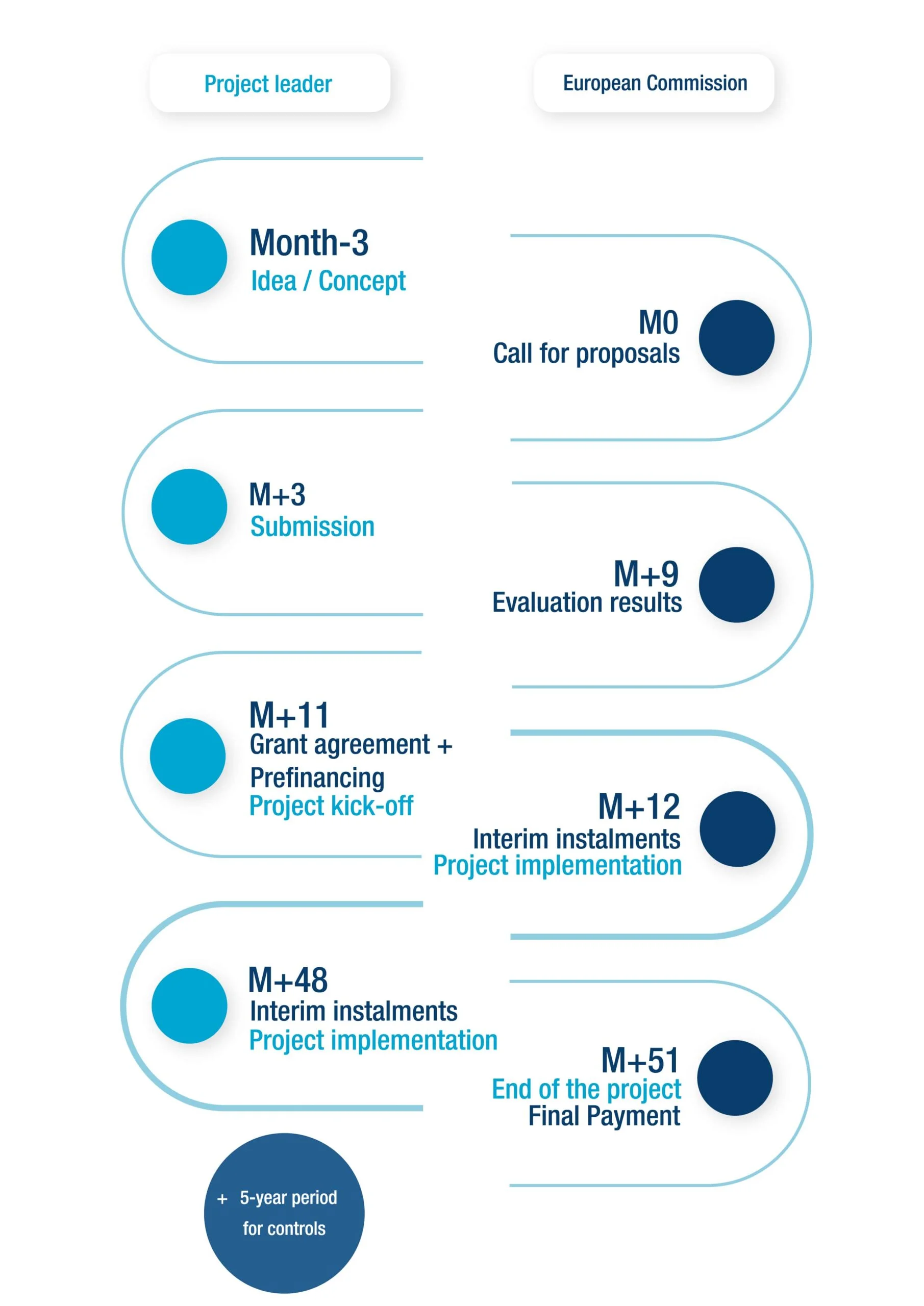
Comment ça marche ?

Need help with your public financing ?

Les autres fonds européens

LIFE

Transition vers une économie durable grâce aux énergies renouvelables

FSE+

Investir dans les citoyens pour une Europe sociale forte

ERASMUS+

Permet le développement des étudiants et de connecter l’Europe

CERV

Promotion de la diversité, l’égalité et les droits dans l’Union Européenne

Horizon Europe

Axée sur l’innovation et la recherche

Digital Europe

Accélérer la transformation numérique

Questions fréquentes

Vous ne trouvez pas la réponse que vous cherchez ?

Le Fonds européen de développement régional (FEDER) est un des principaux instruments financiers de la politique de cohésion de l’Union européenne. Pour la programmation 2021-2027, le FEDER a deux objectifs majeurs : le développement solidaire et durable des territoires et la compétitivité de l’économie. Il vise à réduire les écarts entre les régions et à favoriser le développement dans divers domaines d’intervention comme l’environnement, les énergies renouvelables et le développement urbain.

Pour la période 2021-2027, des milliards d’euros ont été alloués pour soutenir les projets dans les États membres et les régions ultrapériphériques. Les fonds sont répartis en fonction des besoins spécifiques de chaque région, et un taux de cofinancement est généralement appliqué.

Si vous avez un projet qui correspond aux objectifs et aux domaines d’intervention du FEDER, vous pouvez déposer un dossier de demande via le portail des aides. Il est essentiel de suivre la méthodologie du FEDER pour maximiser vos chances d’obtenir une subvention.

Des exemples de projets cofinancés par le FEDER sont souvent publiés sur le portail des aides et sur d’autres plateformes de la Commission européenne. Ces exemples peuvent donner une bonne idée des types de projets qui reçoivent un financement.

La programmation 2021-2027 met un accent particulier sur les transitions écologique et numérique. Elle vise également à renforcer la résilience des régions européennes face aux défis actuels et futurs.

Pour découvrir davantage sur le FEDER, vous pouvez écouter des podcasts, lire des articles, ou même participer à des webinaires et des sessions de formation. Le but est de vous fournir toutes les informations nécessaires pour naviguer efficacement dans le monde des fonds européens.

Ces questions et réponses ne sont qu’un aperçu des nombreux aspects du FEDER. Pour plus d’informations, n’hésitez pas à consulter le portail officiel et les ressources associées.

Need help with your public financing ?

Similar news

25 August 2021

Webinar Horizon Europe: Guide to prepare an accurate financial statement on time

Read the article

9 June 2021

Welcomeurope’s new service!

Read the article